Thailand's Debt Collection Act 2015: hours, limits and debtor rights
A plain-language guide to Thailand's Debt Collection Act B.E. 2558 (2015): who may collect, permitted hours and frequency, workplace contact, prohibited conduct, penalties and how to complain.
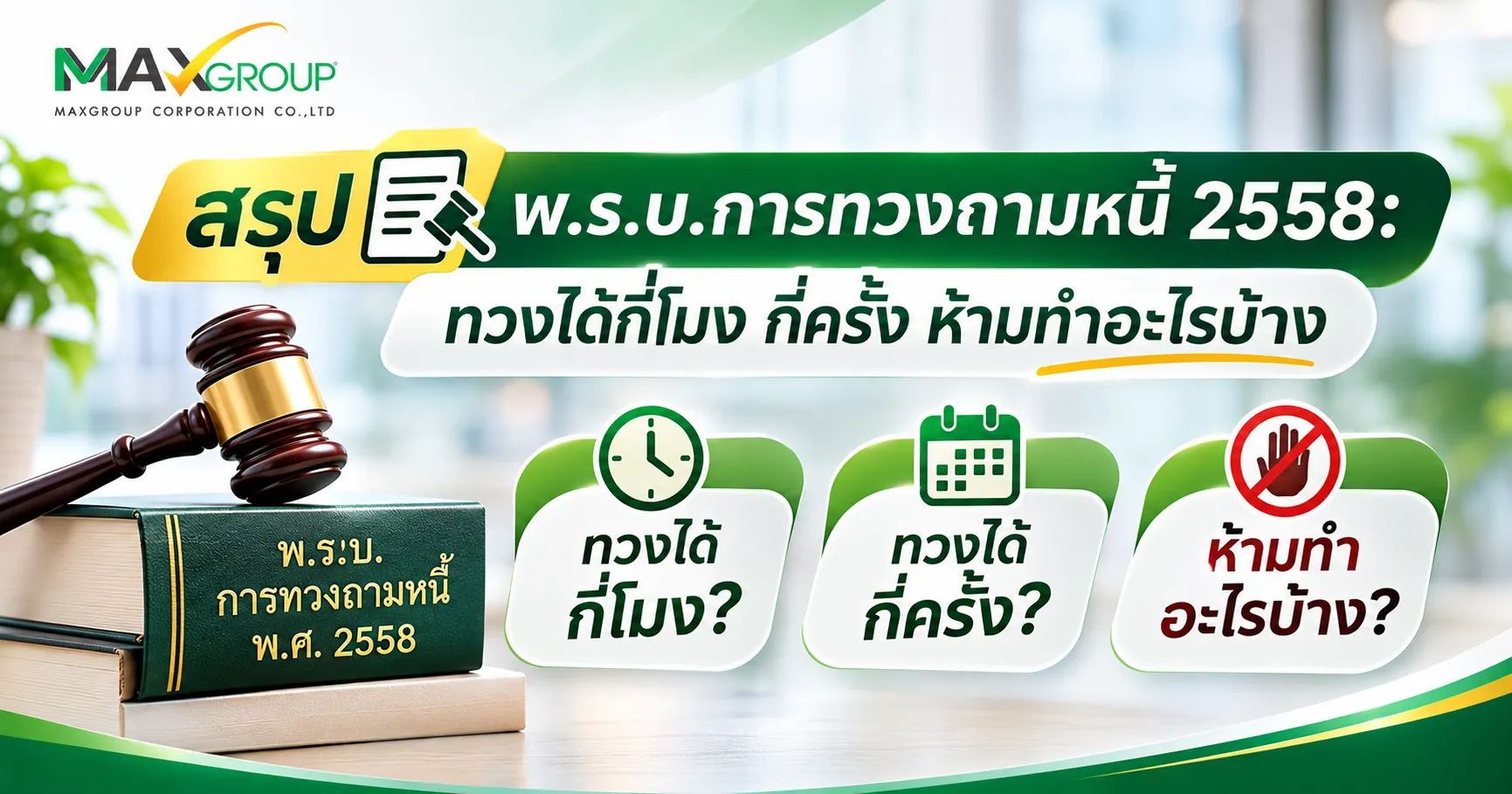
Thailand’s Debt Collection Act B.E. 2558 (2015) regulates debt collection so that it is fair, protects debtors from inappropriate practices, and requires collection businesses to operate transparently. This guide answers the questions debtors and creditors ask most often.
At a glance
| Topic | Rule |
|---|---|
| Hours (working days) | 08:00 – 20:00 |
| Hours (public holidays) | 08:00 – 18:00 |
| Frequency | No more than once a day |
| Who may be contacted | The debtor, or a person the debtor has named |
| Place | The debtor’s domicile, residence or workplace |
| Payment | Directly to the creditor’s account |
Who may collect debts
Under the Act, collectors include lenders that extend credit in the ordinary course of business, people authorised by the creditor, and debt collection businesses, which must be registered as the law requires (lawyers and law offices must be certified by the Lawyers Council of Thailand). All of them must follow the same rules.
Max Group was certified to operate a debt collection business by the Lawyers Council of Thailand on 22 April 2016.
Permitted hours and frequency
Under the Debt Collection Supervisory Committee’s announcement, a collector may contact a debtor:
- On working days between 08:00 and 20:00
- On public holidays between 08:00 and 18:00
- No more than once a day, whether by phone, message or any other channel
Contact outside these hours or more often than allowed breaches the law and can lead to an administrative fine.
Can a collector contact you at work?
The Act allows contact at the debtor’s domicile, residence or workplace, so contacting a debtor at work is not unlawful in itself. However, the collector must not disclose the debt to colleagues, managers or anyone unrelated, and must not collect in a way that embarrasses the debtor or damages their reputation.
When contacting someone else to locate a debtor, the collector must give their name and must not reveal that the contact concerns a debt.
Collector obligations
- Contact only the debtor or a person the debtor has named
- Identify the collector and the creditor that authorised the collection
- Show proof of authorisation when collecting in person
- State the outstanding amount clearly when the debtor asks
- Issue a receipt for every payment received
Prohibited conduct
- Threats, violence, or harm to a person’s body, reputation or property
- Insulting language towards the debtor or others
- Disclosing the debt to unrelated people or shaming the debtor, including on social media
- Envelopes or messages that reveal the contact is about debt collection
- Posing as, or implying one is, a lawyer, government official or government agency
- Falsely suggesting criminal prosecution or seizure of assets
- Charging collection fees above the rates set by the committee
Penalties
- Threats, violence or harm to body, reputation or property — up to 5 years’ imprisonment, a fine of up to THB 500,000, or both
- Insults, disclosing the debt, or posing as a lawyer or official — up to 1 year’s imprisonment, a fine of up to THB 100,000, or both
- Contact outside permitted hours, places or frequency — an administrative fine of up to THB 100,000
Collectors may also be liable under the Criminal Code, for example for defamation or extortion.
What debtors should do when contacted
- Ask for the caller’s name, company and the creditor’s name
- Check the balance directly with your creditor
- Pay only into your creditor’s account — never into a personal account
- Keep evidence such as call recordings, messages or chats if you experience inappropriate collection
Where to complain about unlawful collection
- The collection company, or the creditor that hired it
- The provincial Debt Collection Supervisory Committee, via your district office or provincial hall (in Bangkok, the Metropolitan Police Bureau)
- Your local police station
- The Bank of Thailand’s Financial Consumer Protection Center, hotline 1213 (where the creditor is a financial institution)
Max Group complaints channels
If one of our staff contacts you inappropriately, please call 02-159-9922 ext. 6 or email [email protected]. We will investigate and act fairly.
Further reading
- Can debts be collected via LINE or social media in Thailand?
- Is a creditor liable when its debt collection agency breaks the law?
- How to choose a debt collection agency in Thailand: 7 checks
For creditors: looking for a debt collection agency in Thailand that strictly follows the law? See Max Group’s debt collection services.
This article is general information, not legal advice for any specific case. Details may change with announcements from the Debt Collection Supervisory Committee.